
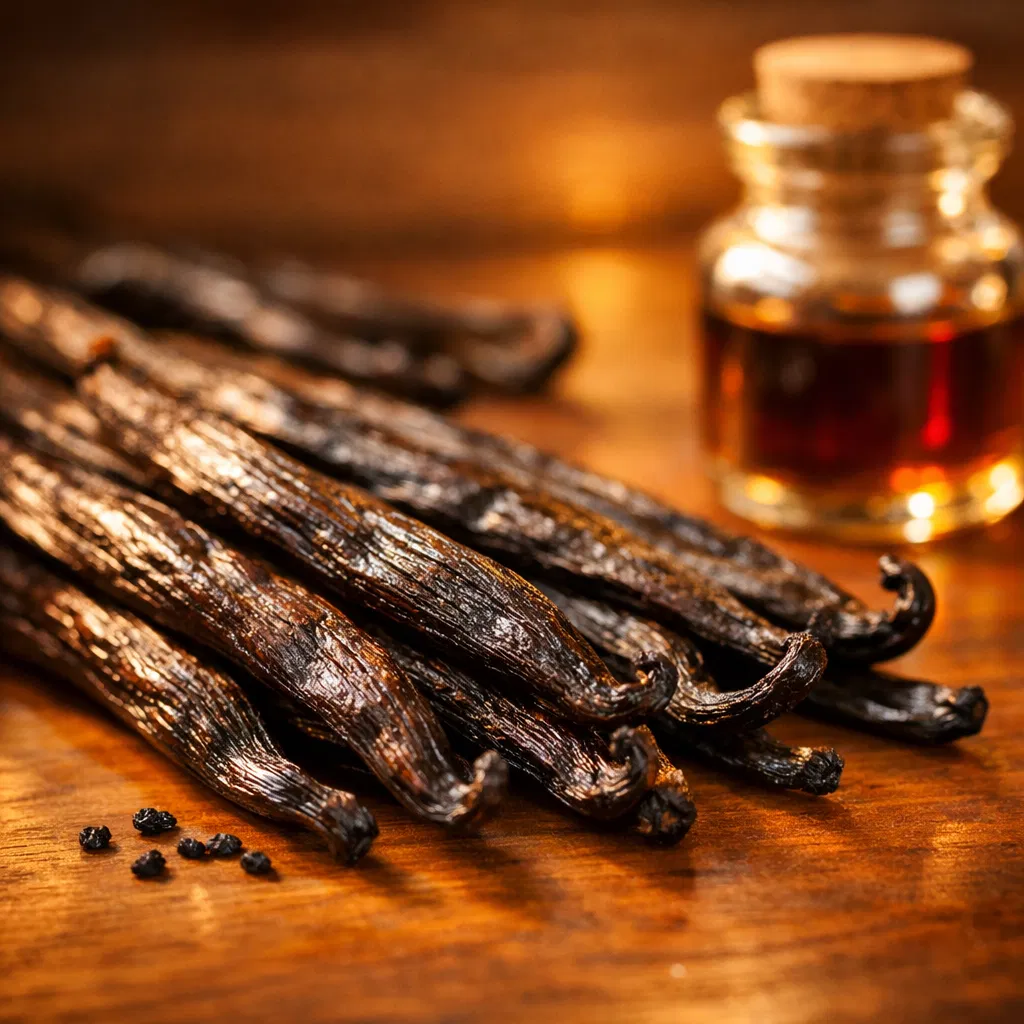
Planifolia & Tahitensis — Whole Pods, Cuts & Splits
Grown on our own farms in North Sulawesi and East Java — not aggregated from unknown sources. Every pod is hand-pollinated, vine-ripened for 9 months, and slow-cured over 4–6 weeks using the traditional sweating method. No shortcuts at any stage. Vanillin content verified per lot by ISO 17025 laboratory analysis.
All beans are graded, cured, and packed at our own post-harvest facility in North Sulawesi. Vanillin content, moisture, and bean length are tested per lot. Full certificate of analysis provided before shipment commitment.
We supply directly to pastry chefs, flavour houses, food manufacturers, extract producers, and fragrance brands. Because we grow our own, there is no minimum we cannot meet — and no provenance claim we cannot verify.
Both varieties are grown on our own land, hand-pollinated, and processed at our own curing facility. No third-party aggregation. Every lot carries full chain-of-custody documentation from vine to export container.
The world's dominant commercial vanilla species. Our Sulawesi-grown planifolia is recognised for a rich, creamy, tobacco-noted profile with vanillin content consistently in the 1.8–2.6% range — higher than the Madagascan average. Grade A pods are plump, dark, and oily after our 5-week traditional cure.
A rarer, more aromatic species with floral, fruity, and anise-like notes derived from heliotropin and piperonal alongside vanillin. Lower vanillin content than planifolia but highly prized by pastry chefs and perfumers. Small-batch seasonal availability — advise volume requirements early.
Visually perfect pods for retail-facing products, artisan bakeries, and luxury food brands. Supple, heavily frosted with vanillin crystals on the surface — a quality indicator often absent from commodity-grade beans.
Identical provenance and curing process to Grade A. Shorter or slightly irregular pods that are analytically equivalent. The rational choice for extract production, flavour compounding, and any application where pod appearance is not the end-use criterion.
Cross-cut pieces from Grade A/B pods. Maximum vanillin extraction yield per kilo. Standard input format for commercial extract houses and fragrance compounders. Full COA and vanillin % per lot.
Vanilla paste (seed paste in sugar or glycerol base) and vanilla powder (spray-dried extract on a starch carrier) available as contract processing. Custom specifications on request. Lead time 3–5 weeks. MOQ: 50 kg.
Vanilla flavour does not exist in the freshly harvested pod. It develops through enzymatic reactions triggered by the curing process. We use the traditional Bourbon-style sweat-cure — the same method that built Madagascar's reputation, applied to our own Indonesian harvest.
Pods harvested by hand when the tip begins to yellow — 9 months after pollination. Timing is critical: too early and vanillin precursors are insufficient; too late and pods split.
Green pods are immersed in 65°C water for 3 minutes. This kills the living tissue and halts further ripening, while activating the enzyme glucovanillin glucosidase.
Blanched pods are wrapped in wool blankets and stored in airtight wooden boxes for 1–2 weeks at 45–65°C. Enzymatic conversion of glucovanillin to vanillin occurs here.
Pods are spread on racks in the shade for 2–3 weeks, then briefly exposed to morning sun. Moisture reduces from ~80% to the target 25–35%. Rushed drying destroys the flavour.
Dried pods rest in closed containers for a further 2–4 weeks to develop complexity, then are graded by length, pliability, and vanillin content. Each lot is lab-tested before release.
The questions importers, flavour houses, and food brands ask most when sourcing Indonesian vanilla for the first time.
Tell us your species preference, grade, volume, intended use, and destination market. We'll respond within 24 hours with pricing, sample availability, and the full COA from our most recent lot. No obligation.
By submitting, you agree to our privacy policy. We never share your data with third parties.